
Dear Diary - a rolling 4 months of comment
10mm Napoleonic a test run.
A couple of months ago I painted up some 10mm Napoleonics as a tester for a fast paint project.
They ended up on the table yesterday and by filling out the armies with blank bases, I set up a Neil Thomas style scenario using the Eagles at Quatre Bras rules and I must say, it was quite a pleasant knock about.
Using the blank bases helped establish a shopping list of what is needed to get this fast paint project up and running to create a pair of Pocket Armies.
The Tractor Works - refight!
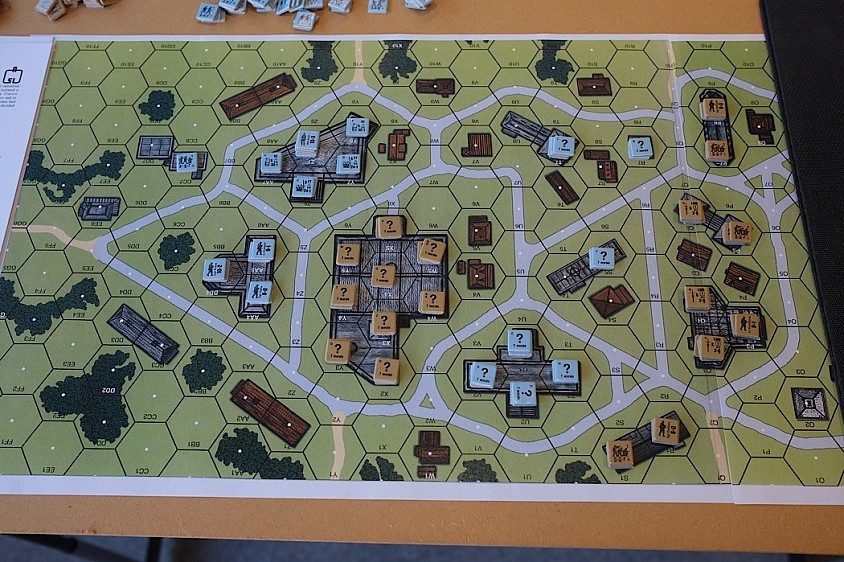
This time, I managed to play 'The Tractor Works' scenario right through and hugely enjoyable it was too, both sides fully engaged throughout.
The game had a different feel to the Guards Counterattack scenario despite what essentially amounts to fighting through a building dominated landscape and I think in this case it was the difference in the force build that did that.
Anyway, there is a write-up over on the Battlefields & Warrior Blog for anyone interested,
LINK
https://battlefieldswarriors.blogspot.com/2026/07/the-tractor-works-squad-leader-aslsk.html
Polish Cuirassiers
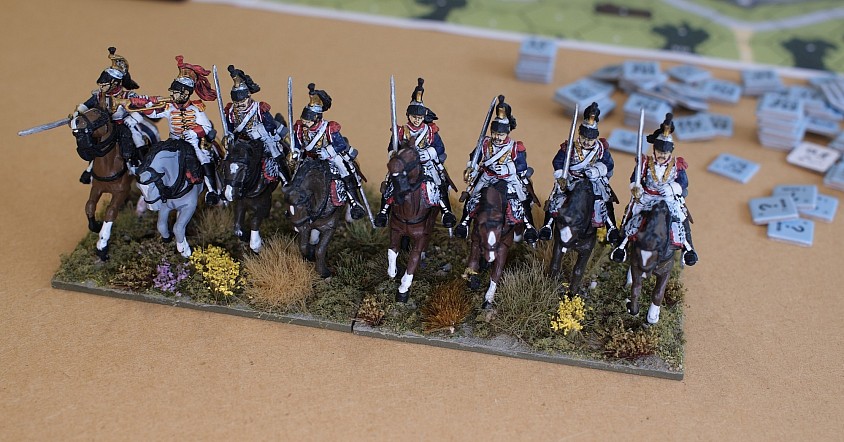
These pre-paints were bought last year from an eBay seller as a group of 12 figures, based as 4 stands of 3’s on 60mm bases, which is pretty standard.
My own basing for Napoleonic cavalry is in groups of 4’s on an 80mm base, with 2 bases per unit, so these have waited in the rebasing queue and eventually got done yesterday.
These are very nicely painted Polish 14th Cuirassiers.
Having used 8 of the 12 figures here, I am left with 4 painted figures, so to make a second unit, I need to paint up 4 more horsemen. I already have them made up in Perry plastic, I just need to paint them and try to copy the painting style, so that they match up - not always an easy thing to do, but hopefully I will get close enough.
Adding the first of two cuirassier units to the collection is a good uplift for scenario versatility and I will be sure to get them into the next game… meanwhile the French skirmishers are STILL on their painting corks! So no movement there.
The background distraction is the ongoing Squad Leader game.
Oh B*&^%$£@!
Having set up the rather good looking 'The Tractor Works' scenario for ASLSK and playing for 2½ hours ...... I suddenly noticed that I had become confused during play and now the sides were prep firing / moving and First Firing in the other sides turn!
There are too many units interacting for the clock to be turned back and so the game has been abandoned, to be set up again!
The German 8-3-8 assault engineers are a powerful force and in my game, they were in the final process of over running the factory, though the Soviet 5-2-7 relief force were also making good headway towards the factory.
Regardless of the mistake, the play itself has been rewarding and so 'once more into the breach"!
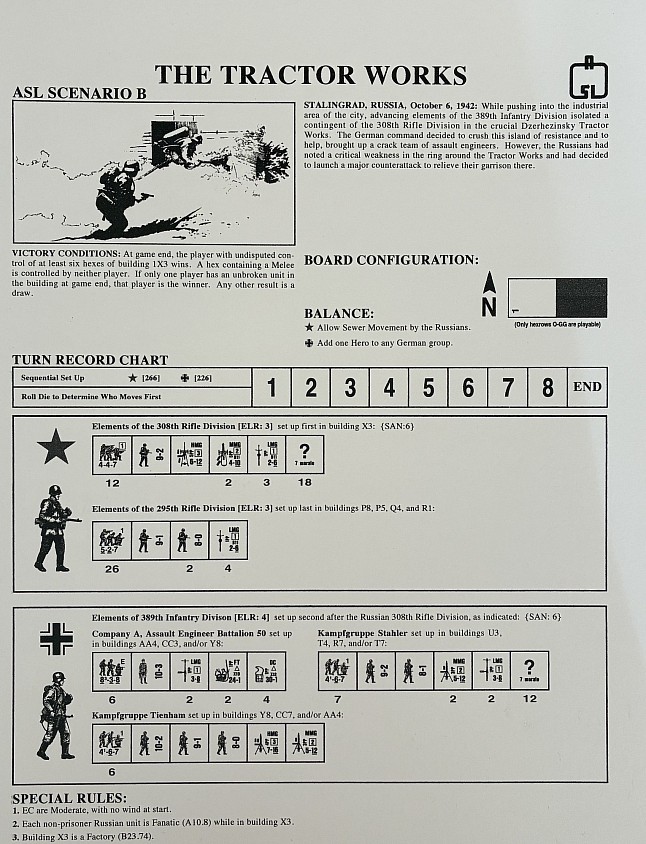
Scenario B going to the table
Having recently played the Guards Counterattack using ASLSK rules, I am setting up the next scenario - The Tractor Works.
This scenario uses the other half of Board 1 and I have also had that enlarged.
There are a lot of infantry in this one, plus specialised engineers, flamethrowers and demo charges, so I am expecting quite a different feel than the last game.
In the future I will be doing scenario C, which combines the Guards Counterattack and the Tractor Works into one game and includes some tanks, so that will be a bit of a game fest and also help reinforce the armour rules in my mind.
Three games of Test and Resolve
I have had another go of the Test & Resolve rules with the Ferrybridge scenario and this time I managed to work through all three linked games.
I am increasingly liking these rules.
There is a write-up with observations and pics at the bog.
LINK
https://battlefieldswarriors.blogspot.com/2026/07/returning-to-ferrybridge-1461.html
Re-basing archers, the Canterbury contingent
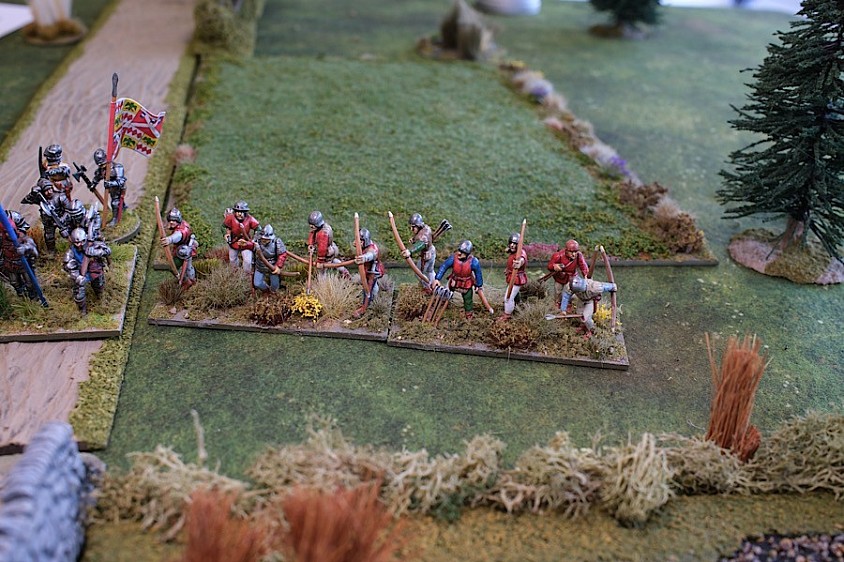
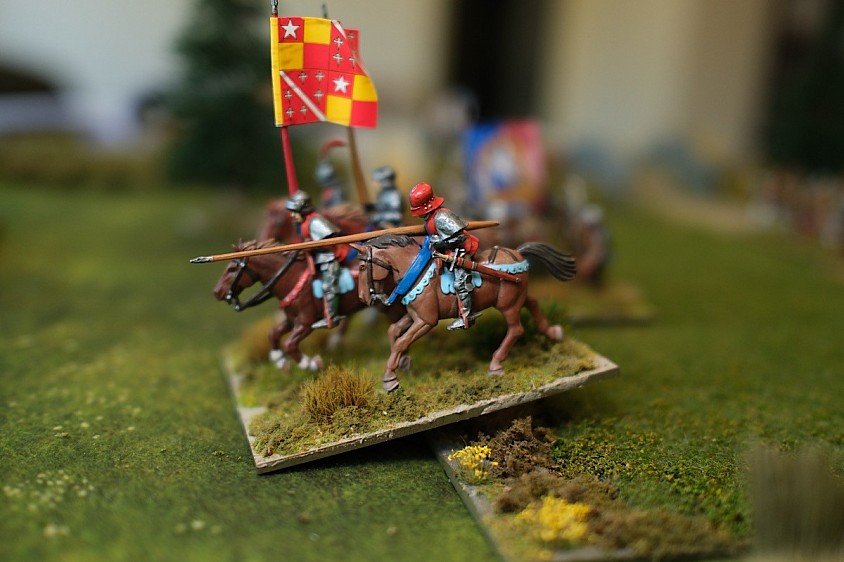
As I re-based the second of my Wars of the Roses archer units, I drew a base from the collection that was labelled ‘Militia’. My re-basing takes a single 80 x 50mm base with 7 - 9 archers and turns that into a two base unit with a total of 10 figures, typically requiring me to paint 1 - 3 new figures and creating two 80 x 40mm bases.
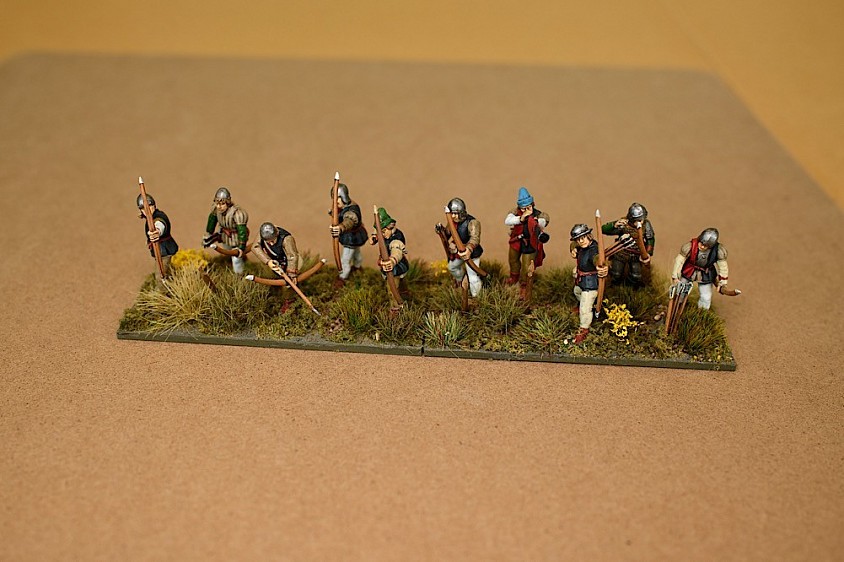
So in this instance 3 figures were painted and the above unit was created. Most of the figures are wearing red and so I have re-named it as the Canterbury archers (militia).
There is a leader in the front line (by the left yellow flower tuft), he will be our captain of the archers and represent William Sallow (also known as Sellow). As with many captains of archery from town militias, he is in fact a senior civic figure, rather than a military man.
The archers were constantly employed in local conflict, though notably were present at Empingham Field 1470.
Note the archer out on the far right who has taken an arrow to just above his knee. This is a conversion to a Perry plastic archer, the method of conversion is described in an earlier post (below).
Robert Horne was a notable from the Kent area, who recruited for the Yorkists from the local area. He fought at Northampton 1460 and was wounded ….. it's a stretch, but perhaps he is our wounded man here.
By chance, at the recent Phalanx war-game show, I picked up the flags / banners for John Wenlock and he was in command of some archers from this area at Towton 1460, so I will do a melee base with his banner to stand side-by-side with the Canterbury archers!
Out of interest, the above shot was taken during a return to the Ferrybridge scenario, which I will post about in due course,
Fighting at the Namur
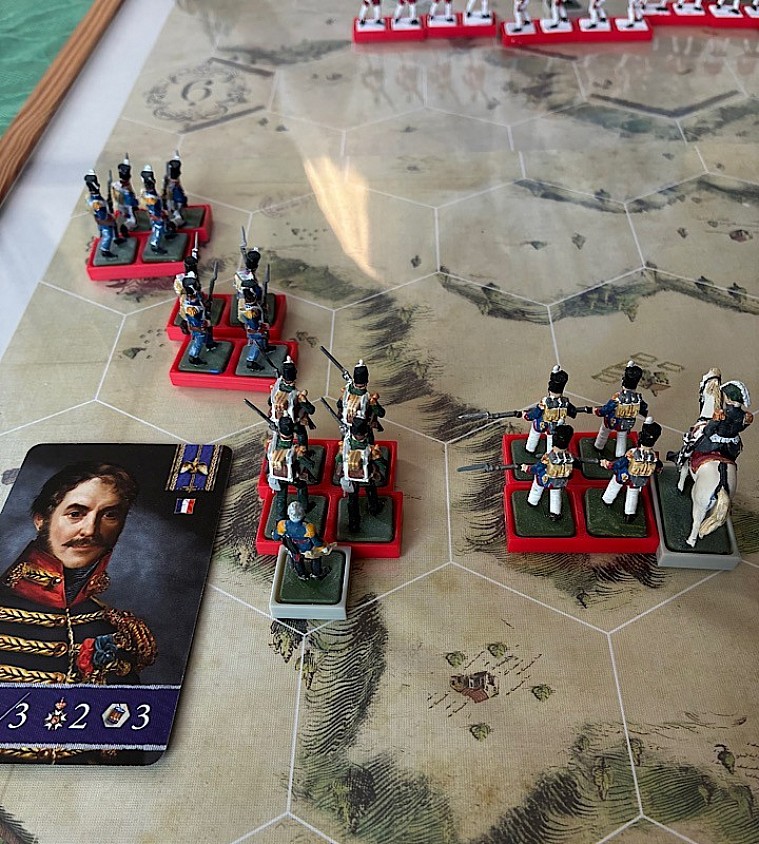
Our face-to-face game yesterday evening fell upon The Eagle and the LION game, published in 2009.
It is a long time since we last looked at this and I can remember the game arriving with some fanfare... but I don't think as a series, it went anywhere after that!
Anyway, it is a mix of plastic figures (look like 1/72) on a hex grid and is a quality production.
The photo shows the left wing of the French attack, with the far left pairing being light infantry and the next pairing being line. Over on the right, out of view, there was another line unit, but it needed to change orders from manoeuvre to attack and over the course of the game, the die rolls needed to make that happen, frustratingly didn't materialise! I can understand a one or two turn delay, but at this game scale, to be out of it for the entire battle felt odd.
Despite having figures in play, it has a touch of the 'Euro game' feel game rather than a tabletop game, including card play, where players have a 'hand' which I felt was a distraction to the actual tactics going on across the board, and I seldom find cards enjoyable at any level. In the end, I just stopped looking at the cards!
There was a brief moment in the centre and I wondered how it might play out if lifted and played out on a traditional figures war-game table, so aesthetically, it does give a figures feel and I enjoyed that aspect.
I was left with the impression that the rules seemed more intricate than they needed to be and that it is the sort of game that is best enjoyed by those who play it regularly and understand all of the nuances.
A shout out for Entoyment
With the re-basing plans for my Wars of the Roses archers, I will need to paint around 30 new figures.
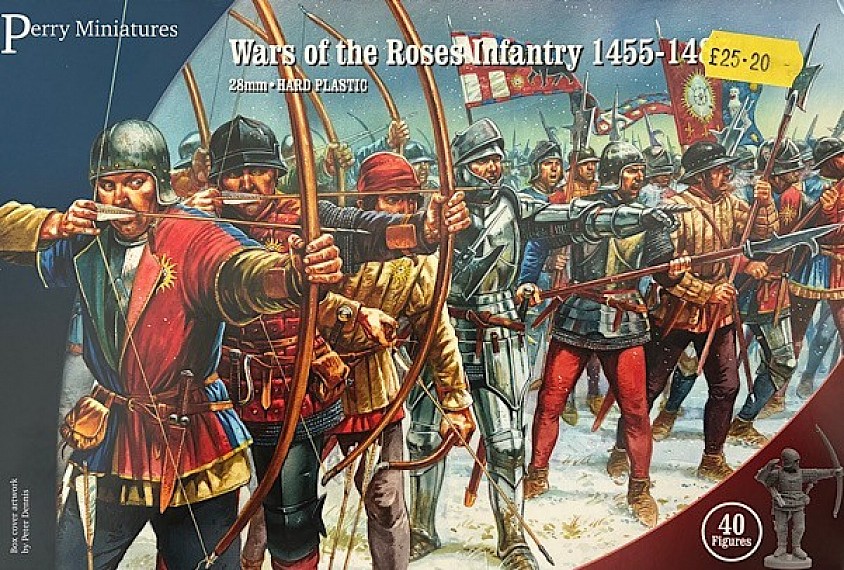
The stash has got low, so an order for a box of Perry plastic Wars of the Roses 28mm infantry was needed. I was also struck that now there isn't a place within a drivable distance that I can visit to buy these sort of things!
Anyway an internet search picked up the Entoyment Wargaming and Hobby Centre, which I believe is a well stock retail unit in Poole (UK), that also has gaming tables etc.
They had a good price (£25.20) on the box set, the postage was fine for tracked, but what surprised me most was that I internet ordered around 1 PM and got an e-mail back at around 3 PM to say that the purchase had been packed and was ready to go with Royal Mail!
Based on that, if you are wanting something pronto, they seem a good go to.
A good read, Bloody Meadow.
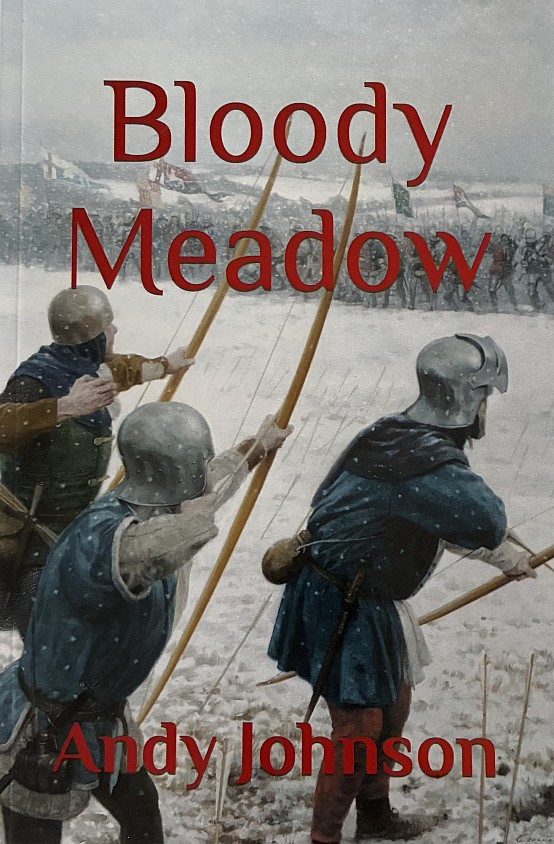
Covering the Battle of Towton 1461 and the Ferrybridge action the previous day, Bloody Meadow is a work of fiction; a dramatisation of historical events. Authored by Andy Johnson and published in 2023, as a publisher is not identified, I assume this may be a self-published book.
I picked up my signed copy from the author at the Partizan Wargame Show in May 2026. The show has a Writer’s Corner and three authors had attended.
From the first page, I was enthralled by this page turner. It begins with the account of Ferrybridge, a series of ongoing actions the previous day to the main Towton battle.
It is an easy read that gives a vivid account of the action and gives voice to not only some of the main participants, but of the common soldier such as Jack and Sim, together with their captains.
At various points in the story, I checked back to some of my sources and found the factual part of the story to be strong.
I am presently getting my Wars of the Roses wargame armies back to the table and have just adopted a new set of rules that I am quite taken by. Those rules have a Ferrybridge and Towton scenarios and when putting Ferrybridge game onto the table, I found myself reading the gameplay in the language of the book - that is, having read the book, a mental picture of character and the feel of actual battle, through the vivid nature of Johnson’s writing, allows what is going on in the game to hang off that.
I am about to read The Wars of the Roses, Volume 1, The Triumph of York 1455-1461, published by Helion and I imagine the same will be true, with the text of one enhancing the text of the other.
One of the debatable things about the fighting in the Wars of the Roses is how archers were deployed. Bodies of men would arrive at the battlefield supplied by the various magnates and towns etc, but we are not sure to the degree that archers were separated out from billmen and whether they fought as separate entities or in close association with their own community.
Towton itself clearly opened as an archers battle and the text usefully describes how archers under their captains would be placed out in front of their respective armies and at a given point would retire behind the bill, once the close quarter fighting was about to begin, but there might then be a more confused picture as gaps threatened in the line and archers were pressed back into service.
The fighting along the front line is vividly described, it was brutal and arms, armour and military experience mattered. The fight was exhausting and men would need to be rotated out of the line for rest, while all the time trying not to slip on the muddy, bloody and body-strewn battlefield.
It was a brutal affair with blade going through bone and all manner of flesh being exposed and clothing covered with the blood and flesh of others.
At the top of this were the men of power and influence, often driven by revenge for the earlier loss of a brother or father, seeking out particular enemy banners of those held responsible or that simple knowledge that they had pinned their colours to one side or the other and if they lost, they would almost certainly be executed and their lands taken.
At the other end was the common soldiery, there just because they were obligated to their immediate hierarchy, pressed into service and once fighting, literally pressed into the press of men that were hacking away at each other.
The battle itself is noted for having been the largest on British soil, together with having the highest casualty rate, fought on a freezing winter's day, when snow blizzards were cutting vision down and commanders could not see what was unfolding and the ground thick with churned up mud. There is so much material here to weave into a cohesive story and Johnson has done a very good job.
The air seemed to be alive with arrows, slicing without pause into the tightly packed column - page 9
Lord Grey was amongst the assembly, his banner sporting the black ragged staff, as were Lords Scrope, Clinton and Audley - page 41
The bouchier family were well represented along with knights such as Sir William Herbert and Sir Walter Devereux and of course Warwick’s old favourite, Sir John Conyers.
As the enemy billman dropped down heavily onto one knee, the man-at-arms to Conner’s right, smashed him over the head with his own war axe - page 97
The crest and upper slope of the Ridgeline was a carpet of dead and dying men, several thousand of them already - page 99
“At the sound of three trumpet blasts, begin the advance” - page 119
Having fought to the point of exhaustion, one side or the other must give this time - page 127
“Chase them down!” He roared again, then, looking back over his shoulder, “horses forwards! Get the horses forward! Ride them down, Start the pursuit! Let none of them escape!” - 145
Whilst others were simply pushed over and trampled by their comrades, who were fighting desperately to escape - page 155
A nice find
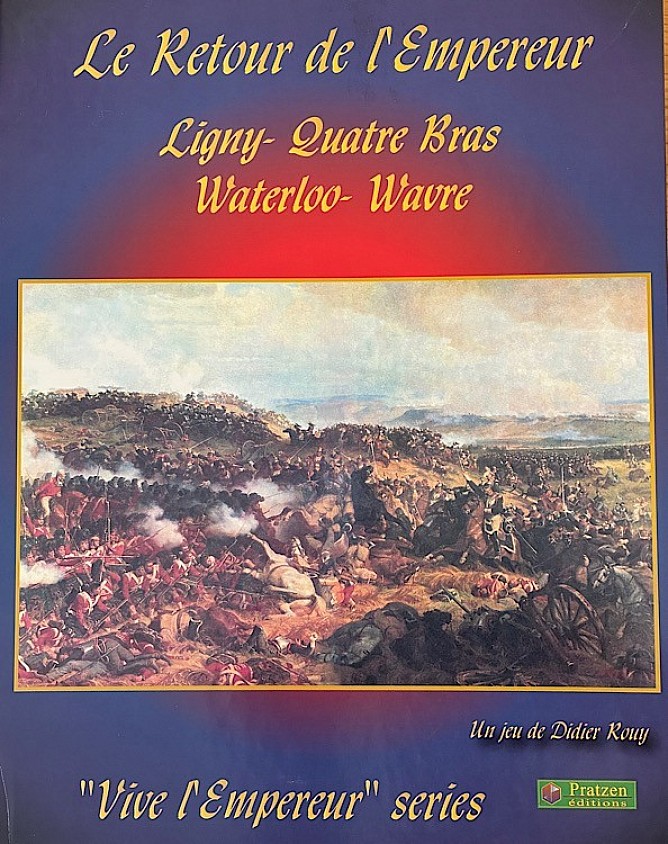
I have started to collect the Vive l'Empereur boardgames series, designed by Didier Rouy. It deals with large Napoleonic battles 1805 - 1815.
Waterloo was published in 2011 and I suppose it could be described as a slow burn series as it seems to take a while for a title to come to print and on the back of that there seems to be a reluctance to go back and reprint the older titles, because the new stuff is taking the focus (Wagram is about to be released by Legion Games).
So as someone a little late to the party I feel quite fortunate that I have come across the Waterloo set at a kind price.
This package covers the Ligny - Quatre Bras - Wavre and Waterloo actions across 30 scenarios, which include 'What if's' and the campaign game.
The package is presented by 6 maps, scaled at 250 metres to the hex. It is a very visual series, the map has large hexes that accommodate the oblong shaped counters that allow the units to be represented in either column or line.
Waterloo packages have cropped up quite regularly over the years and as I grab them, I typically play the smaller Quatre Bras first as it is often the easiest to get to the table and so it will be here..... soon to be seizing Gemioncourt and pushing onto the crossroads!
Rebased archers
A few posts below, I discussed the proposed re-basing of the Wars of the Roses longbow bases and the first example is now done.
These were Lord Percy's archers (Northumberland) and so had tunic colours of red / black. They were a group of 9 figures on an 80x50 base and since I need two bases per archer company in Test of Resolve rules, I was cycling through my archer collection of old sized bases pretty quickly, leaving me unable to do the medium to bigger scenarios.
I have decided per unit to go with 2 x 80mm bases, a bit shallower at 40mm and just having 5 figures per base (10 per unit).
So as I come to deal with each old base of 7 - 9 figures, I will need to paint 1 - 3 new figures to stretch things to a 10 figure unit.
If you look at the photo a few posts back and then the photo here, you will see the difference at a glance.
The task took longer than I thought, several hours, just to convert 1 base!
I actually prefer the more linear, less densely packed look of the new unit.
I took the opportunity to remove the die tray at the back of the old base and to add a few sharpened stakes along the line - not immediately obvious, but they reveal themselves when you stare into the base.
For my billmen, rather than re-basing, I am just using one 80 x 60mm base instead of two bases, one behind the other. This is hugely more economical and the formations do not look like they are in column, so I'm glad I took my time thinking about this instead of racing at it.
Archer conversion
For the re-basing that I will be doing for the archers, I will need between 1 - 3 newly built and painted figures per new two-based unit.
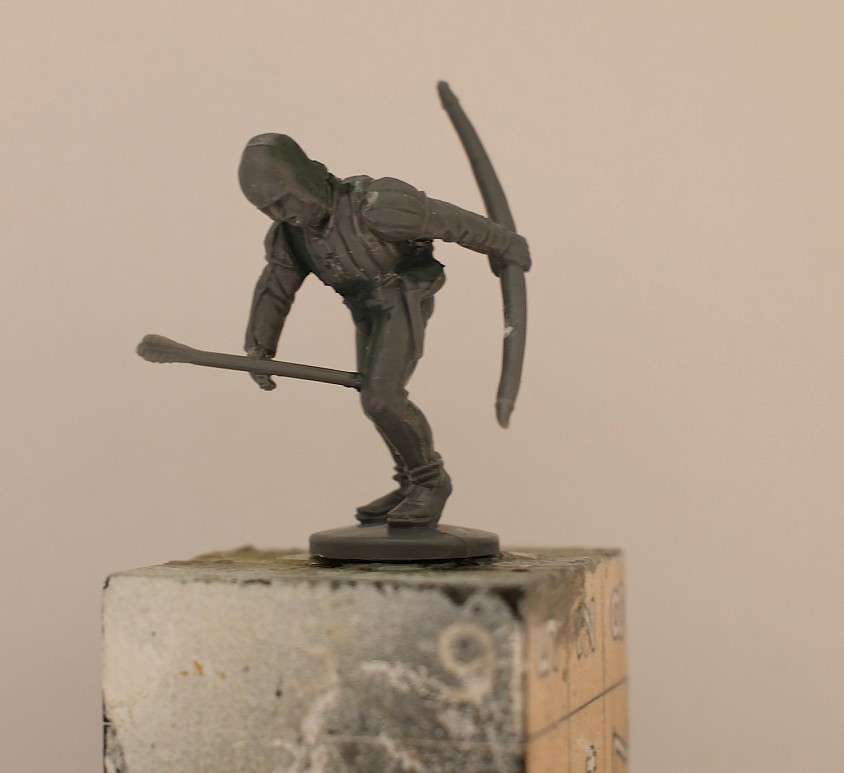
This afternoon I cut and built some more plastic Perry archer parts from the sprue and decided to have a go at doing a conversion for a wounded man.
This figure was upright to start with. A razor saw cut him in half and then with a knife the plastic around the midriff was cut away to effectively give a 'V' shape cut to the belly, so when glued back together, he was leaning / tumbling forwards.
A small hole was drilled above his left knee to take the arrow.
The rest of the parts came from the sprue without modification. The arrow was cut from the 'arrow clump' that you get, an extended right arm was added to reach for the arrow shaft and the left arm carries the bow thrown rearwards as he tries to keep his balance.
The head is obviously bowed forwards and I chose one with a face that had the mouth open, as no doubt he will be calling out in pain or swearing at the enemy archers!
Finally a bit of Liquid Green was used on some joins to hide any gaps, plus there were two annoying sink holes in the helmet that needed filling.
Next job is to prime him and then decide whose force he will join. Lord Stanley's archers are a favourite of mine and will be done next, so perhaps he will join them!
Fighting for Ferrybridge 1461
The day before the Battle of Towton, there was a running minor action at Ferrybridge.
The Test & Resolve scenario book nicely divides that into three separate actions, which I have dipped my toe into and given some observations over on the Battlefields & warrior Blog.
Link
https://battlefieldswarriors.blogspot.com/2026/07/battle-of-ferrybridge-parts-i-ii-and-ii.html